The Broken Promise of Consulting Marketing: Why the Old Methods Are Failing

Peter O'Donoghue
Business Development Expert
Is your consulting firm stuck in the feast or famine cycle?
One quarter you're overwhelmed with client work, your team is maxed out, and you're turning down opportunities. Then suddenly, projects end simultaneously, and you're staring at a half-empty calendar and revenue projections that make you break into a cold sweat.
Why Consulting Marketing Is Fundamentally Broken (Whether You're Solo or Leading a Team)
After years of building your expertise and reputation, you expected client acquisition to become easier, not harder. But the reality of running a consulting practice today reveals a painful truth: the methods that worked in the past are failing consultants at an alarming rate - whether you're an independent expert or leading a boutique firm.
Here's why:
The Referral Myth: You've been told that great work leads to referrals. While this occasionally happens, relying on referrals creates dangerous unpredictability. When they dry up (and they always do), you're left starting from zero with no systematic way to generate new opportunities. For team leaders, this means potentially disappointing your consultants with reduced workloads or, worse, having difficult conversations about downsizing.
The Content Hamster Wheel: Everyone says you need to "create content" and "build thought leadership." So you and your team invest countless hours writing articles and posting on LinkedIn, only to watch your brilliant insights disappear into the void. The promised inbound leads rarely materialize, leaving everyone exhausted and questioning whether their expertise is truly valued in the market.
The Digital Marketing Disconnect: Traditional digital marketing was designed for products, not high-value consulting services. The agencies you hire apply cookie-cutter approaches that fail to convey your firm's unique expertise, resulting in low-quality leads that waste your consultants' time and drain your collective confidence.
The Team Utilisation Challenge: For boutique firm leaders, inconsistent marketing creates the impossible task of keeping your team fully utilised. You find yourself in the uncomfortable position of either having consultants on the bench (costing you money) or overworking your team during busy periods (risking burnout and quality issues).
The Credibility Paradox: Despite your years of experience and proven results, you're competing against less qualified consultants who simply market themselves better. This creates the maddening situation where expertise alone isn't enough to win clients - you need a marketing system that properly showcases your team's collective value.
The Real Impact: Beyond Just Revenue
When this happens, everyone shifts into panic mode.
You start frantically posting on LinkedIn, your team scrambles to reach out to old contacts, and you might even consider taking on less than ideal clients just to keep the lights on.
But by then, it's too late. You're facing the dreaded revenue gap that threatens team morale, financial stability, and your reputation as a leader.
The consequences extend far beyond just finances:
Professional Identity Crisis: After years of success in your field, you start questioning your value and expertise. "If we're so good at what we do, why are we struggling to find clients?" This emotional toll undermines confidence in client meetings and negotiations, whether you're pitching solo or leading your team.
Leadership Credibility: For firm leaders, inconsistent client flow erodes your team's confidence in your leadership. Your consultants start wondering if they made the right choice joining your firm, and the best talent might begin looking elsewhere for stability.
Relationship Strain: The stress of financial uncertainty creates tension at home. Your spouse wonders why you left a stable position for this rollercoaster. You find yourself missing important family moments because you're constantly thinking about where your next client will come from and how to keep your team busy.
Freedom Illusion: The independence you sought by building your consulting practice becomes a cruel joke. Instead of working on your terms, you're trapped in a cycle of accepting whatever work comes your way, regardless of whether it energizes you, utilizes your highest-value skills, or plays to your team's strengths.
Legacy Concerns: As you look toward the future, you worry about building something sustainable. Without a predictable client acquisition system, your consulting practice remains perpetually vulnerable, making long-term planning and growth impossible - whether that means scaling your solo practice or expanding your boutique firm.
What if instead of this reactive scramble, you had a marketing system that ran consistently whether your team was deep in client work or strategically planning your next move?
Let's see how to build a marketing machine that works without needing constant tweaking.
STEP 1. Map Your Annual Campaign Calendar: The Strategic Foundation
You didn't become a successful consultant by winging it with clients. So why approach your marketing that way?
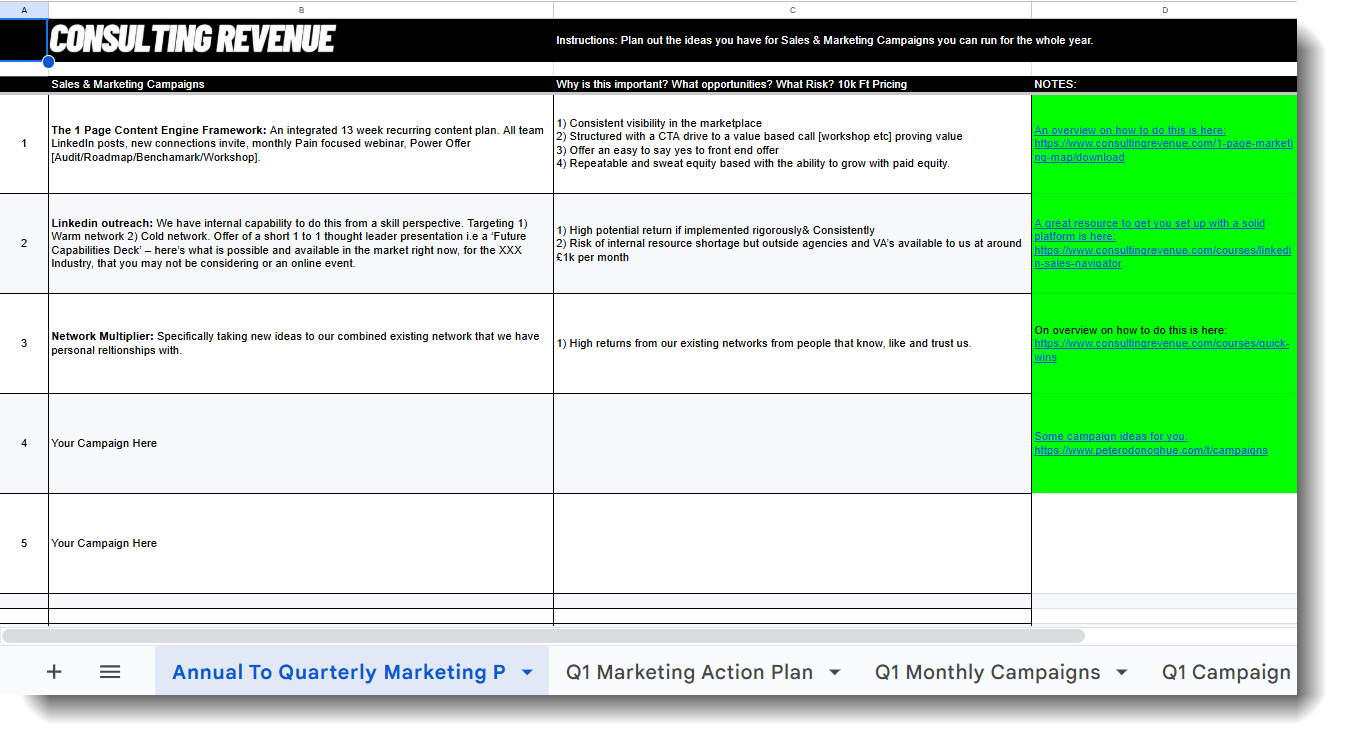
The foundation of a self-running marketing system is planning campaigns for the entire year not just the next month or quarter. This strategic approach creates the predictability you crave and eliminates that nagging anxiety about where your next client will come from.
Start by brainstorming all potential campaign types your firm could run:
- Executive Briefings: Position yourself as the thought leader who understands what keeps decision makers up at night
- Industry Benchmarking Studies: Showcase your analytical expertise while generating valuable data that attracts attention
- Webinar Series: Demonstrate your methodologies in action, creating "mini-experiences" of working with your firm
- Roundtable Events: Facilitate valuable connections while establishing yourself as the convener of important conversations
- Capability Briefings: Showcase your proven frameworks that have delivered results for similar clients
Want to implement this in your consultancy?
Book a free diagnostic to see where your revenue is hiding.
For solo consultants, this approach prevents the feast or famine cycle that leads to taking on misaligned projects out of desperation. For firm leaders, it creates predictable business development opportunities your team can count on, boosting their confidence in your leadership.
The key is to include at least one evergreen campaign: something that can run continuously throughout the year without major updates. This creates your baseline of consistent opportunity generation, even when you're at capacity with client work. Think of it as your marketing insurance policy against those panic-inducing dry spells.
STEP 2. Narrow Down to Quarterly Focus: From Overwhelm to Execution
The reason most consultants fail at marketing isn't lack of ideas - it's trying to execute too many initiatives simultaneously.
This quarter by quarter approach creates the focus that's been missing from your previous marketing attempts.
With your annual map in place, zoom in on the upcoming quarter and select specific campaigns to implement. This prevents the overwhelming feeling of having too many marketing balls in the air while ensuring nothing falls through the cracks.
Evaluate each potential campaign by four key criteria:
- Anticipated cost: Not just money, but the precious resources of your time and team bandwidth
- Expected return: Beyond raw leads, consider strategic positioning and relationship building value
- Ease of implementation: Be brutally honest about what's realistic given your client and team workload
- Strategic alignment: How this builds toward your firm's reputation in your target market
For solo practitioners, this process prevents the scattered approach that leaves you exhausted without results. For firm leaders, it creates clear priorities your team can rally around, allowing everyone to contribute to business development in ways that play to their strengths.
The ideal campaigns combine easy implementation with high returns. For example, a client success story series requires minimal time investment but showcases your results, while a complex primary research project might deliver tremendous value but require resources you can't spare this quarter.
STEP 3. Create Monthly Implementation Plans: Where Strategy Meets Execution
This is where most marketing plans fall apart for consultants - the gap between strategy and execution. You're brilliant at strategic thinking for clients, but when it comes to your own marketing, vague ideas rarely translate into consistent action.
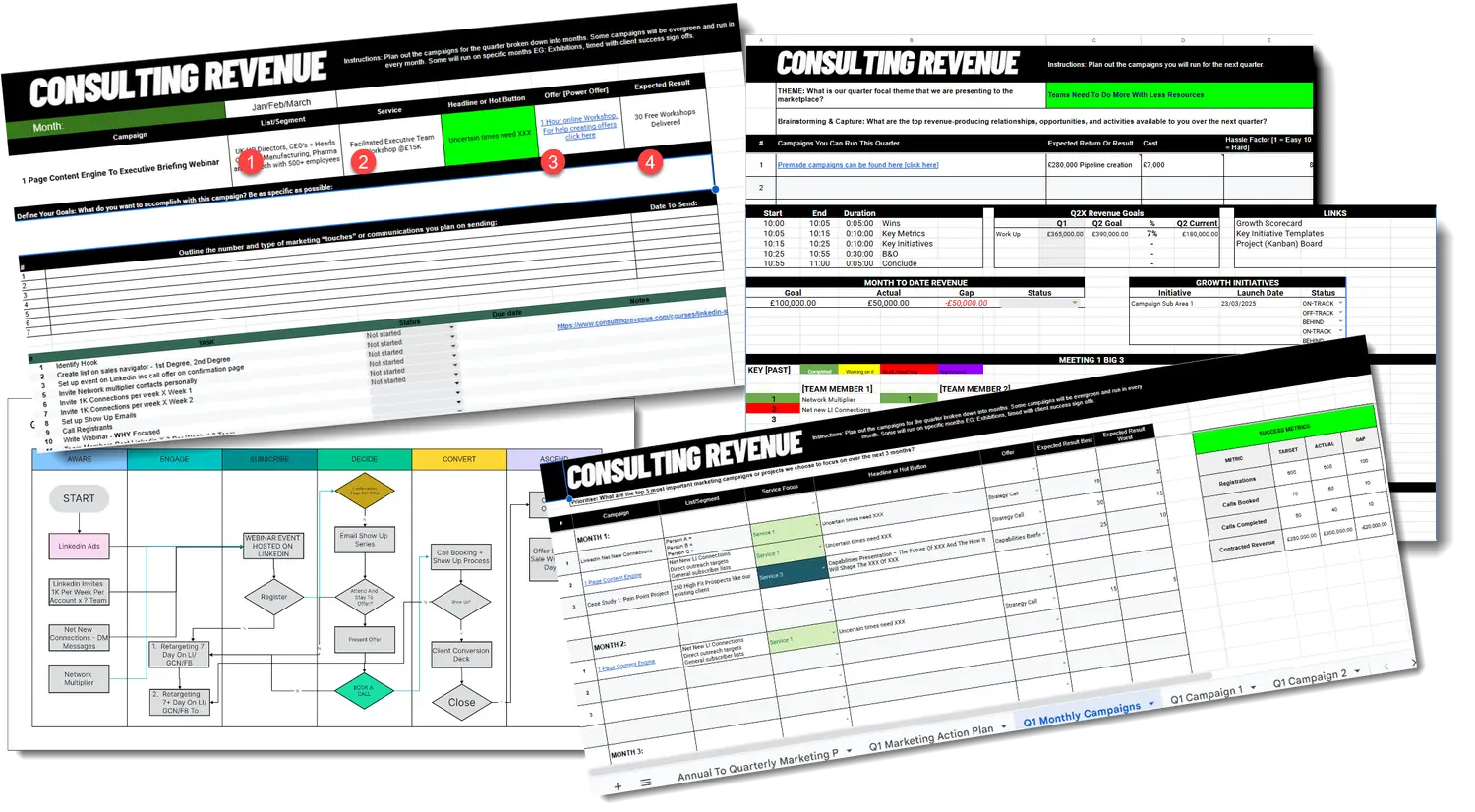
Bridge this gap by breaking your quarterly campaigns into concrete monthly action plans with clear owners and deadlines - just as you would for a client implementation.
For each month, define with absolute clarity:
The specificity is what sets successful consulting marketers apart. Rather than "run a webinar," your plan should specify details that eliminate vague anxiety and replace it with confident clarity.
STEP 4. Design Your Campaign Strategy: Stand Out in a Crowded Market
The most devastating realization for experienced consultants is discovering that expertise alone doesn't win clients. Your campaign strategy is where you translate that hard-won knowledge into messaging that resonates with decision-makers.
This critical step prevents the common consulting trap of creating content that's technically brilliant but fails to generate leads because it doesn't speak to what keeps your prospects awake at night.
Start by defining with surgical precision:
For solo consultants, this clarity helps you stop wasting time on marketing that doesn't convert. For firm leaders, it ensures everyone on your team understands how their expertise fits into your go-to-market strategy.
Then create your unique point of view - the perspective that differentiates you from competing firms. This isn't just about being different; it's about articulating why your approach delivers superior results for clients with specific challenges.
STEP 5. Monitor, Measure, and Iterate: From Hope to Certainty
The final element that separates successful consulting firms from those trapped in the feast or famine cycle is their approach to measurement. Without clear metrics, you're left hoping your marketing works rather than knowing it does.
Create a simple tracking system that helps you stay accountable and optimise results without getting lost in vanity metrics that don't impact your bottom line.
Focus on tracking these crucial indicators:
For solo consultants, this creates confidence that your marketing investment is paying off. For firm leaders, it provides transparency about what's working and allows you to quickly identify bottlenecks in your marketing process.
Most importantly, this approach transforms marketing from a mysterious art into a science - one where you can predictably generate opportunities when you need them, rather than hoping the phone rings.
The System That Breaks the Feast-or-Famine Cycle
The true power of this system isn't in any individual campaign it's in the consistent execution quarter after quarter.
When properly implemented, this approach means you're no longer the bottleneck in your own marketing, whether you're a solo consultant or leading a team of experts.
For consulting firm leaders, this system creates an additional benefit: it allows your team to contribute to business development in a structured way, even if sales isn't their primary strength.
Imagine the confidence that comes from knowing exactly how many qualified prospects you'll speak with next month, regardless of whether you're currently swamped with client work or eagerly seeking new projects.
Start small, focus on execution, and build on what works. Before long, you'll have a marketing system that runs like clockwork, so you and your team can focus on doing your best work rather than constantly selling it.
This comprehensive consulting marketing system should be combined with LinkedIn presence, thought leadership, and proactive outreach to maximize results.
Need help building your system? Our advisory services provide strategic guidance, while our fractional BD director services offer hands-on implementation support. Book a diagnostic call to discuss your situation.
Build a BD System That Runs Without You
Download the Revenue Engine Builder. A strategic and tactical framework for building a repeatable, predictable business development system inside your consultancy.