The Simple 6-Step Sales Process to Creating an Unlimited Supply of B2B Prospects


Peter O'Donoghue
Business Development Expert
Do you ever feel like you could win far more business if you could just find a way to get in front of more of the business people you want to connect with?
You may have experienced significant challenges around creating consistent new business pipelines. Relying on referrals is becoming increasingly ineffective. And even if it was working out OK for you, it's still outside of your control and cannot be planned and scaled.
If you've felt frustrated, confused or 'dead in the water' and don't know what to do to create consistent high quality first meetings with your ideal prospects, then relax. There is a solution.
How to Dictate Any Number of High Quality First Meetings
During this guide, I'll show you a simple 6-step prospecting system that will allow you to dictate any number of high quality first meetings you want with your dream prospects each and every month - without relying on anyone else or feeling like you're constantly begging them to introduce you to other people.
This guide will hand you those 6 steps on a plate. I hope to clear all of your confusion and overwhelm and show you just how simple it really is to create a predictable business where your new client pipeline is always full.
The 3 Ways of Outbound Prospecting
1) Cold Calling
When we mention outbound prospecting you may have frozen a little and maybe instinctively recoiled. You had a gut reaction. And maybe even a sense of fear that I was going to tell you about a remarkable new elevator pitch, cold call opening line or even a new method to 'overcome' the gatekeeper.
RELAX. You have nothing to fear. Nothing I outline for you is about cold calling.
I can make cold calling work, and given enough time and desire on your part, I can make you into a star cold caller. BUT:
2) LinkedIn
There are three main reasons I'd suggest this is no longer an effective outbound strategy:
i) Everyone's sending LinkedIn messages
LinkedIn is becoming a hotbed of automated messages from fake profiles and endless invites. This creates an environment where messages are lost among a sea of spam.
ii) Communication preferences are changing
Around 80% of LinkedIn contacts use their personal email address, not their work email. People also want to safeguard their access in the event of a sudden job change.
Therefore, you're contacting people with a business message that's going to their personal account. And the higher up in an organization you go, the chances of them logging into LinkedIn decrease significantly.
iii) Cold Emailing (Our Recommended Approach)
What you're about to be shown is a systemized way of identifying highly qualified prospects based on your Ideal Prospect Profile (IPP), along with a process that makes first contact via a systemized cold-emailing program.
We often see results like this:
- 70% response rates to your cold email
- 60% of those responses turned into a first meeting
- That's a staggering 30% of the people you contact eventually turn into a first meeting
The 6 Stages of a Cold Emailing System
Want to implement this in your consultancy?
Book a free diagnostic to see where your revenue is hiding.
Stage 1: Create A Value Based Sales Structure
Question: What value do you contribute on your first engagement with a prospect?
To effectively 'SELL' the value of engaging with you, you have to ensure you have created enough PERCEIVED value that can be articulated as to why someone should invest 20 or 30 minutes of their time with you.
Without value, why would anyone apart from those really desperate for a solution agree to it?
Stage 2: Develop Your Ideal Prospect Profile (IPP)
The first stage in defining your IPP is to look at the characteristics of the best 20% of your existing clients. We take clients through quite an in-depth process based on:
- Tangible characteristics: Location, industry, size, what software platform they are using, job titles
- Intangible characteristics: Level of conservatism, attitude to growth, beliefs about external service providers
- Red flags: Things they say or do that indicate they wouldn't be a great fit
Stage 3: Build Highly Targeted Lists
Once you have identified your IPP, the next stage is to identify the key individuals in those businesses.
Traditional methods using B2B list brokers are outdated. Their data is increasingly out of date and bounce rates can be up to 40%. With the tools I'm going to show you, we can get the bounce rate down to as low as 3%.
The technology to build highly targeted lists and source contact details has developed more in the last 2 years than in the 20 years prior. Services like Ringlead Capture and egrabber allow you to select information anywhere on any webpage and capture it to a spreadsheet.
Stage 4: Find Email Addresses at Scale
Once you have your list of companies and key people, you need to find their email addresses.
Tools like:
- Hunter.io - Find email addresses from domains
- Clearbit Connect - Chrome extension for finding emails
- Voila Norbert - Email finder with verification
- Snov.io - All-in-one prospecting solution
These tools have transformed the ability to find verified email addresses at scale.
Stage 5: Warm Up Your Sending Domain
Before sending cold emails at scale, you need to warm up your sending domain to avoid spam filters. This involves:
1. Start with a new domain (not your main business domain)
2. Send gradually increasing volumes over 2-4 weeks
3. Ensure high engagement rates initially
4. Use email warmup tools like Mailwarm or Lemwarm
Stage 6: Create Your Email Sequences
Your cold email sequence should include:
Email 1: The Value Proposition
Subject: [Specific insight about their business]
Body: Share one specific value point relevant to them
Email 2: The Case Study (3 days later)
Subject: Re: [Original subject]
Body: Brief case study showing results for similar company
Email 3: The Direct Ask (3 days later)
Subject: Re: [Original subject]
Body: Simple, direct request for 15-minute call
Email 4: The Breakup (5 days later)
Subject: Should I close your file?
Body: Let them know you'll stop reaching out unless they respond
Making It Work
The key to success with this system is consistency and testing. Track everything:
Then optimize based on what works. This isn't a "set it and forget it" system - it's a living, breathing process that gets better with iteration.
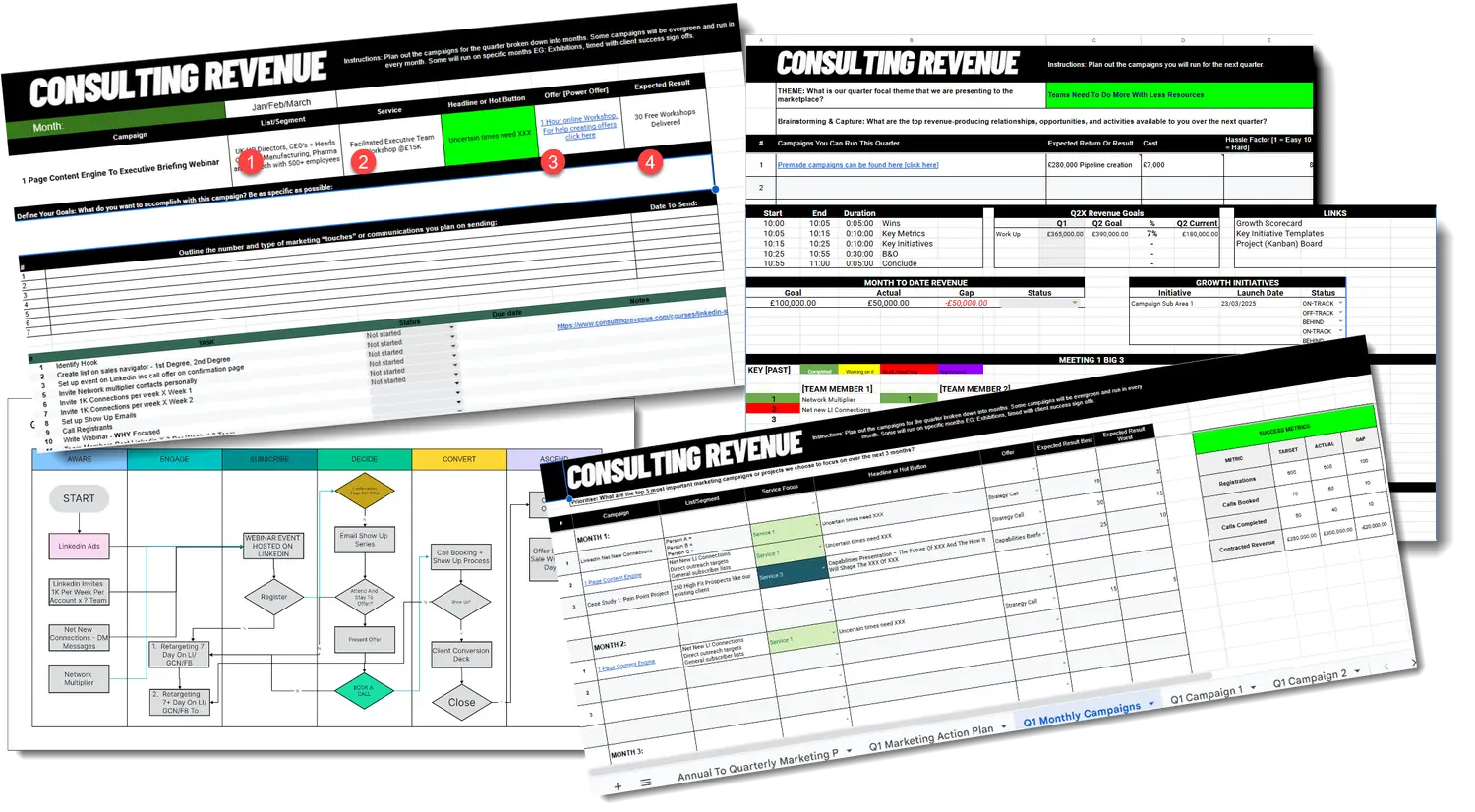
Build a BD System That Runs Without You
Download the Revenue Engine Builder. A strategic and tactical framework for building a repeatable, predictable business development system inside your consultancy.